Inheritance of fields of study
@online{Altmejd_2024_InheritanceFieldsStudy,
  title = {Inheritance of Fields of Study},
  author = {Altmejd, Adam},
  date = {2024-05-03},
  series = {Working {{Papers}}},
  number = {11113},
  eprinttype = {CESifo},
  url = {https://www.ifo.de/DocDL/cesifo1_wp11113.pdf},
  pubstate = {prepublished}
}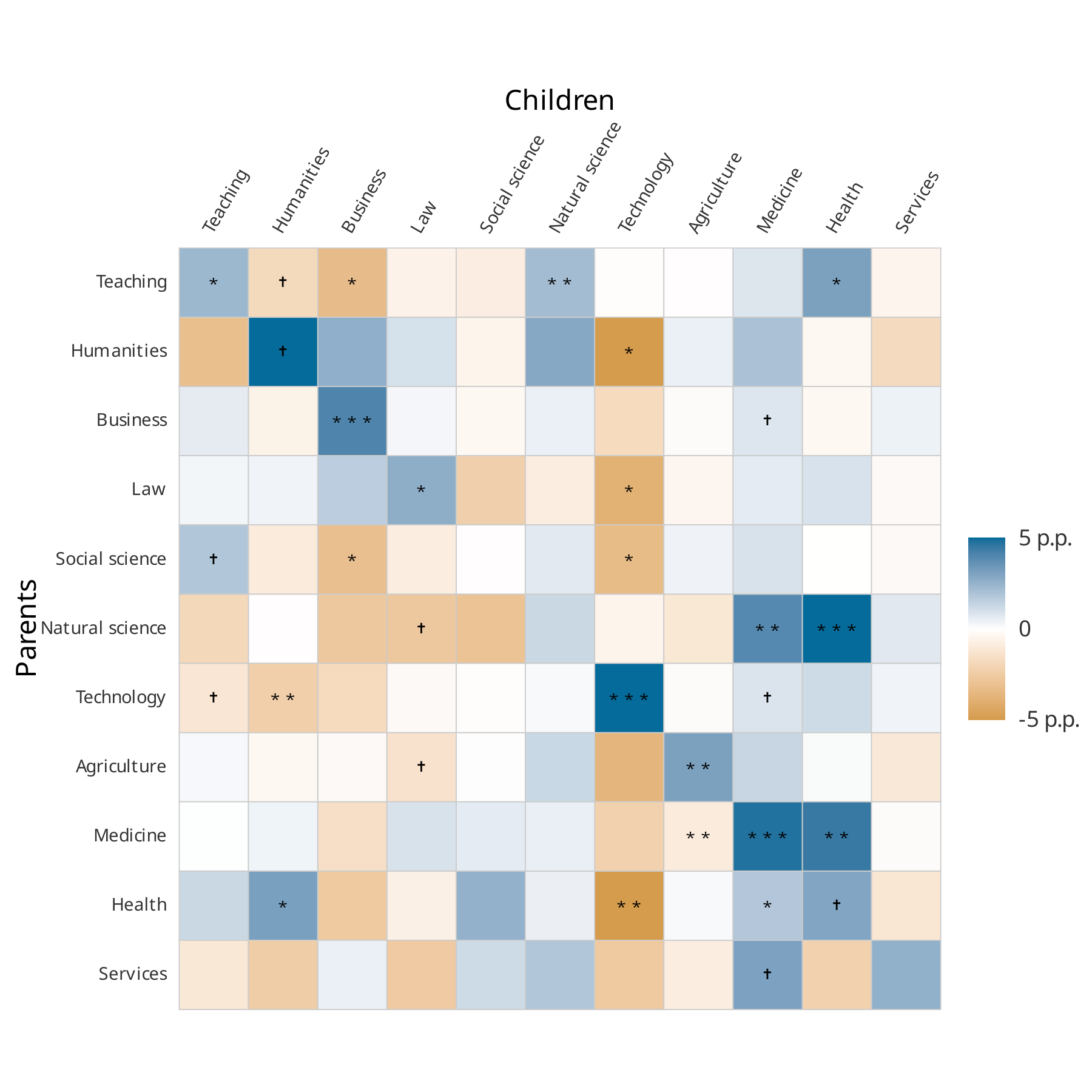
Abstract
Children of university graduates are twice as likely to earn a degree in their parent's field. I link Swedish university applicants from 1977–1992 to their children's later outcomes and exploit admission thresholds in a fuzzy regression discontinuity design. When a parent earns a degree in a broad field, the probability that the child later graduates from that field rises by 4.6 percentage points (46%). Parental STEM enrollment raises children's math scores by 0.18 standard deviations, but children who follow a parent earn about 30% lower returns to their field choice. Transmission is especially strong when parents choose gender-atypical fields.