Nowcasting COVID-19 Statistics Reported with Delay: A Case-Study of Sweden and the UK
@article{AltmejdRocklovWallin_2023_NowcastingCOVID19Statistics,
  title = {Nowcasting {{COVID-19}} Statistics Reported with Delay: A Case-Study of Sweden and the {{UK}}},
  author = {Altmejd, Adam and Rocklöv, Joacim and Wallin, Jonas},
  date = {2023-01},
  journaltitle = {International Journal of Environmental Research and Public Health},
  volume = {20},
  number = {4},
  pages = {3040},
  issn = {1660-4601},
  doi = {10.3390/ijerph20043040},
  langid = {english}
}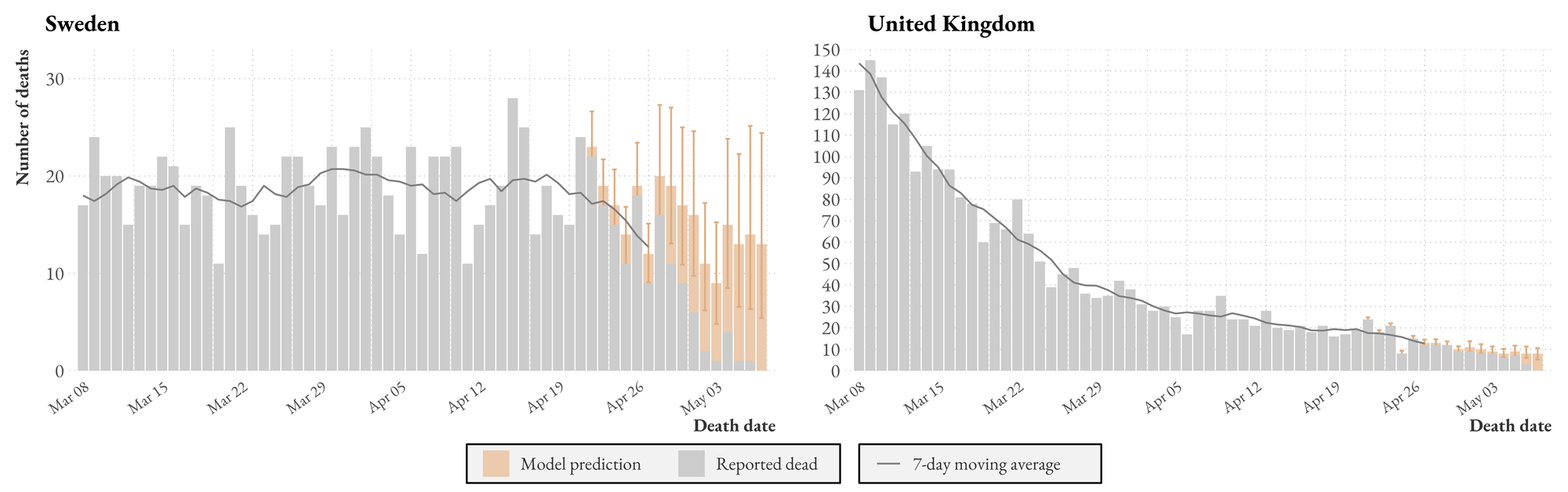
Abstract
The COVID-19 pandemic has demonstrated the importance of unbiased, real-time statistics of trends in disease events in order to achieve an effective response. Because of reporting delays, real-time statistics frequently underestimate the total number of infections, hospitalizations and deaths. When studied by event date, such delays also risk creating an illusion of a downward trend. Here, we describe a statistical methodology for predicting true daily quantities and their uncertainty, estimated using historical reporting delays. The methodology takes into account the observed distribution pattern of the lag. It is derived from the "removal method"—a well-established estimation framework in the field of ecology.